 Visit the US Site

Learn how to choose the right pipe joint safety covers, including flange spray shields and safety shields, using pressure, temperature, chemical compatibility, inspection needs and installation conditions.
Selecting a Safety Shield Requires More Than Matching the Pipe Size
Flange spray shields, safety shields and pipe joint safety covers are secondary protective devices fitted around mechanical pipe connections. Their purpose is not to stop a gasket from leaking, but to contain, diffuse or redirect an unexpected release so that a concentrated jet or spray is less likely to reach nearby personnel and equipment.
The correct shield depends on the actual service conditions. A product that performs well on a low-temperature chemical line may be unsuitable for high-temperature steam, while a mechanically robust metal shield may not provide the chemical compatibility or visual inspection features needed elsewhere. For most applications, selection begins with three primary factors: pressure, temperature and chemical compatibility.
| Selection factor | What to establish | Why it matters |
|---|---|---|
| Pressure | Flange class, normal operating pressure, upset conditions and connection geometry | Influences sizing, construction and the energy of a potential release |
| Temperature | Normal and maximum operating temperature, including start-up and shutdown conditions | Determines whether fabrics, fasteners, windows and seals remain suitable |
| Chemical compatibility | Process fluid, concentration, phase and possible reaction products | Prevents degradation and supports suitable visibility, drainage and containment features |
How does flange class affect safety-shield selection?
Flange pressure class and safety-shield performance are related, but they are not the same measurement. ASME flange classes such as Class 150, 300, 600, 900, 1500 and 2500 describe a flange system whose allowable working pressure varies with material and temperature. The class also changes the flange outside diameter, thickness and bolt arrangement, which affects the physical size of the shield.
A shield therefore has to fit the connection geometry and also be suitable for the energy and characteristics of a possible release. Specifying a shield only as "for a Class 300 flange" does not confirm suitability for every Class 300 application. The actual operating pressure, temperature, fluid and potential upset conditions still need to be considered.
Independent testing and product-specific limits
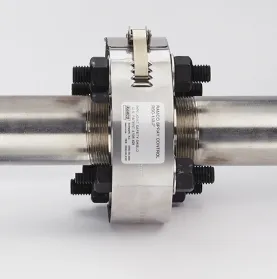
Performance claims should be based on the relevant product construction and supporting test evidence. RAMCO® fabric shield materials have been assessed using independent laboratory methods, including Mullen burst testing to ASTM D3786 where applicable. RAMCO® Spray Control™ stainless steel shields have also been independently spray-tested by TREO in Germany at pressures up to 300 bar. Certain stainless steel constructions are additionally covered by DNV Type Approval for SOLAS applications.
These tests provide useful evidence, but they do not create a single universal rating for every shield, fluid or installation. The applicable product data sheet, certificate scope and operating conditions should be checked during specification.
Key distinction: flange class determines connection geometry and pressure-temperature capability. The shield's own suitability depends on its construction, test evidence and the real service conditions.
How do I choose a safety shield for the operating temperature?
Safety-shield materials have defined temperature limits. Selection should be based on the highest and lowest temperatures the shield may experience, not only the usual steady-state temperature shown on an operating screen.
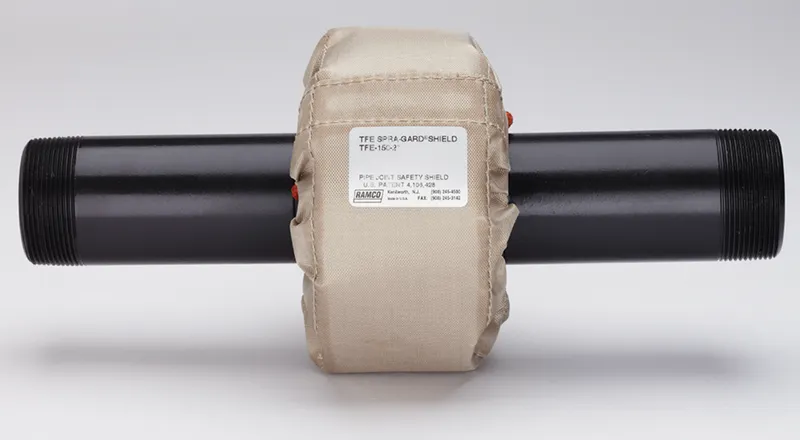
Fabric shields such as TFE Spra-Gard® can be suitable across a wide range of chemical applications, but the exact polymer and construction must remain within its stated limits. Stainless steel shields are commonly selected for high-temperature steam, hot oil and other mechanically demanding services. Even then, the complete assembly and installation method must be assessed rather than assuming that stainless steel alone makes the shield suitable for any temperature.
Which shield material is compatible with my process fluid?
Chemical compatibility is usually assessed against the process fluid, concentration and operating temperature. A current chemical-resistance chart should be used, supported by application-specific advice where mixtures, contamination or unusual conditions are involved.
Matching the shield material to the piping material can be a useful initial reference, but it should not replace a proper compatibility assessment. The shield may contain several different materials, and all wetted or potentially exposed components need to remain suitable.
What is the difference between transparent and opaque pipe joint safety covers?
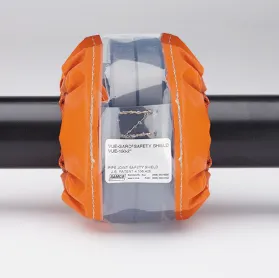
Transparent (clear ETFE) shields allow direct visual leak detection of the flange or joint, while opaque fabric constructions offer broader chemical resistance but hide developing deposits. On neutral-pH fluids a transparent shield is more useful than a colour-changing patch, whereas on crystallising fluids the clear design surfaces residue without removing the shield. The trade-off is UV durability and temperature resistance, which favour opaque constructions in exposed service.
Which shield construction is appropriate - PTFE-based or stainless steel?
| Construction | Often selected for | Points to check |
|---|---|---|
| PTFE / TFE-based fabric shields | Broad chemical resistance, acids, alkalis and general chemical processing | Temperature limit, UV exposure, closure materials, pressure evidence and whether visibility or drainage is required |
| Stainless steel shields | Steam, hot oils, fuels, offshore service and mechanically demanding installations | Grade, mesh or diffusion layer, clasp design, corrosion environment, drain arrangement and certificate scope |
| Transparent inspection shields | Applications where routine visual monitoring is required | Chemical and temperature suitability of the clear section, UV exposure and whether deposits may obscure visibility |
Additional Selection Factors That Are Often Overlooked
Indoor, outdoor and offshore exposure
Outdoor shields may be exposed to ultraviolet light, weathering, salt and temperature cycling. TFE Spra-Gard™ contains a natural UV inhibitor and can provide a longer service life than less weather-resistant fabric constructions in exposed locations. Offshore and marine applications may additionally require corrosion-resistant materials and evidence aligned with the project specification or classification requirements.
Pedestrian areas and drains
Where flanges are located above walkways, access routes or working areas, controlling the direction of a release is especially important. A drain connection can channel collected liquid towards suitable containment and help reduce pooling or slip hazards. The drain route itself must be compatible with the process fluid and must not create a new exposure point.
Inspection and leak visibility
A shield should not hide developing leakage from operators. Transparent designs such as Vue-Gard®, inspection windows, drain indicators or compatible leak-detection coatings can help preserve visual inspection. This is particularly relevant where the process medium is neutral in pH, where a colour-changing pH patch would not activate, or where a crystallising fluid may leave a visible deposit.
Connection type and installation access
Flanges are not the only potential spray points. Valves, expansion joints, hoses, pump connections and threaded or socket-weld components may require different shield geometries. Clearance around the connection, nearby instruments, insulation and the ability to install or remove the shield safely should be considered before ordering.
Common safety-shield selection mistakes
Safety-shield selection checklist
| Confirm | Information required |
|---|---|
| Connection | Type, nominal size, standard, flange class and outside dimensions |
| Process medium | Chemical name, concentration, phase and possible contaminants |
| Pressure | Normal operating pressure, maximum pressure and credible upset conditions |
| Temperature | Normal, minimum and maximum temperatures, including cleaning and start-up |
| Location | Indoor, outdoor, offshore, pedestrian area or restricted-access zone |
| Inspection | Need for clear visibility, indicator patch, leak-detection coating or drain |
| Certification | Customer specification, test evidence, DNV/SOLAS or other project requirements |
| Installation | Available clearance, orientation, insulation, obstructions and safe access |
Frequently Asked Questions
How do I choose the correct flange-guard material?
Start with chemical compatibility, operating temperature and the characteristics of a possible release. Then consider pressure, flange geometry, location, inspection requirements and any applicable test or certification requirements.
Does flange pressure class determine which safety shield is required?
It determines the physical flange geometry and contributes to the operating envelope, but it does not determine suitability on its own. Actual pressure, temperature, fluid and shield construction must also be assessed.
What type of safety shield is generally used for steam?
Stainless steel shields such as RAMCO Spray Control (RSC) are commonly selected for high-temperature steam because of their temperature resistance and mechanical durability. The selected construction should still be checked against the actual pressure, temperature and project specification.
Can PTFE safety shields be used outdoors?
Suitable TFE-based constructions can be used outdoors, but UV exposure, weathering, temperature cycling and expected service life should be considered. Product-specific outdoor suitability should be confirmed.
What shield should be used for hydrofluoric acid?
The complete shield construction must be compatible with HF, and fibreglass-containing constructions should be avoided where HF contact is possible. RAMCO® PPL Spra-Gard™ is a non-fibreglass option intended for this type of service.
When is a transparent safety shield useful?
It is useful where routine visual inspection is required, where leaking media may crystallise or stain, or where a neutral-pH fluid would not activate a pH indicator patch.
Should a flange guard include a drain?
A drain may be appropriate above walkways or where collected liquid needs to be directed to containment. The drain material, route and receiving system must be suitable for the process fluid.
Do safety shields prevent flange leaks?
No. They are secondary protective devices intended to help manage the consequences of leakage. Correct design, installation, gasket selection, inspection and maintenance remain the primary controls.
Summary
Correct safety-shield selection is application-specific. Pressure, temperature and chemical compatibility form the starting point, but flange geometry, environmental exposure, inspection needs, drainage and certification requirements can be equally important. The safest specification is based on the complete operating environment and supported by product-specific technical data and independent test evidence.
Related Reading
View Products
Have a question about this topic?
Contact our technical team