 Visit the US Site

Learn what flange guards are, where they are used, how material selection affects performance, and why they form part of a broader industrial piping safety strategy.
What Is a Flange Guard?
A flange guard, often referred to as a safety shield or spray shield, is installed around a flanged pipe connection to help manage the effects of an unexpected leak. Rather than preventing a gasket failure, it is designed to control or redirect the release of process media, reducing the risk of a concentrated spray reaching nearby personnel, equipment or surrounding plant.
Why Flange Guards Are Used
Flanged joints are essential because they allow inspection, maintenance and equipment replacement. However, every mechanical joint introduces the possibility of leakage through gasket degradation, bolt load variation, vibration, corrosion or thermal cycling.
Where process fluids are hazardous, corrosive, high-temperature or environmentally sensitive, many operators install secondary protection around identified flange locations as part of a wider engineering risk-management strategy.
Typical Applications
Flange guards are commonly specified across chemical processing, petrochemical and refining, offshore and marine installations, utilities, power generation, water treatment and general manufacturing. Selection is driven by application risk rather than industry alone.
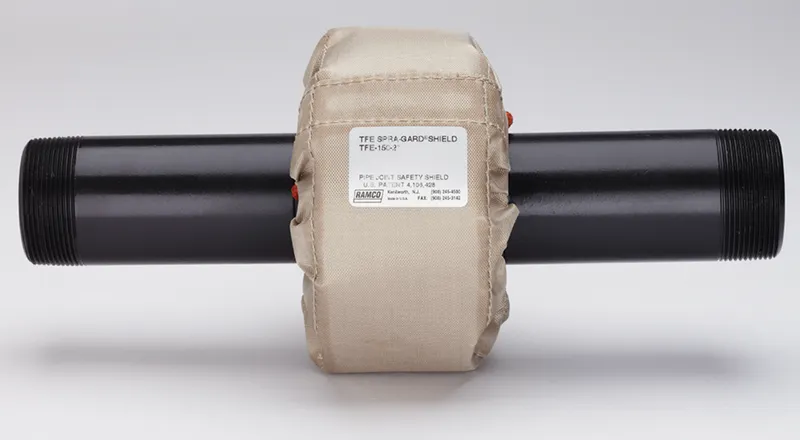
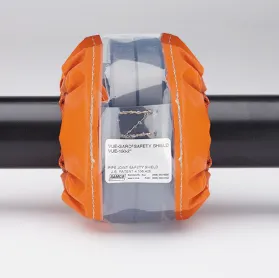
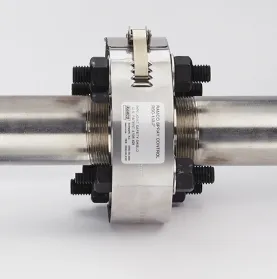
For aggressive chemical service, review TFE Spra-Gard® shields. For steam, hot oils and mechanically demanding locations, consider RAMCO Spray Control (RSC) stainless steel shields. Where operators need to see the flange during routine checks, transparent Vue-Gard® shields offer an inspection-focused option. Each construction must still be checked against the actual operating conditions.
Selecting the Correct Material
No single material is suitable for every application.
Material selection should always consider chemical compatibility, operating temperature, pressure, environmental exposure and inspection requirements.
Performance Considerations
Choosing the correct shield involves more than matching pipe size. Pressure class, flange geometry, drain requirements, UV exposure, accessibility and the physical characteristics of the process fluid all influence the most appropriate solution. Correct specification improves both installation quality and long-term performance.
Compare the sizes and flange options listed for TFE Spra-Gard®, Vue-Gard® and RSC metal shields, then use the safety shield selection guide to review suitability beyond dimensions alone.
Flange Guards Are Not a Substitute for Maintenance
Safety shields are secondary protective devices. They complement good engineering practice but do not replace correct gasket selection, torque procedures, inspection programmes or mechanical integrity management. The most effective approach combines prevention, inspection and consequence reduction.
Where visual leak indication is part of the inspection programme, leak detecting paint can provide a supplementary colour-change indicator for compatible process media. If a shield covers the coated area, an appropriate transparent Vue-Gard® design should preserve visibility of that indication.
Frequently Asked Questions
Do flange guards stop leaks?
No. They are designed to help manage the release from a leak rather than prevent gasket failure.
Where should flange guards be installed?
Typically on higher-consequence flange locations identified through engineering judgement or plant risk assessments.
Can one material be used everywhere?
Generally no. Material selection depends on the process fluid, operating temperature, pressure and environmental conditions.
Related Reading
View Products
Have a question about this topic?
Contact our technical team